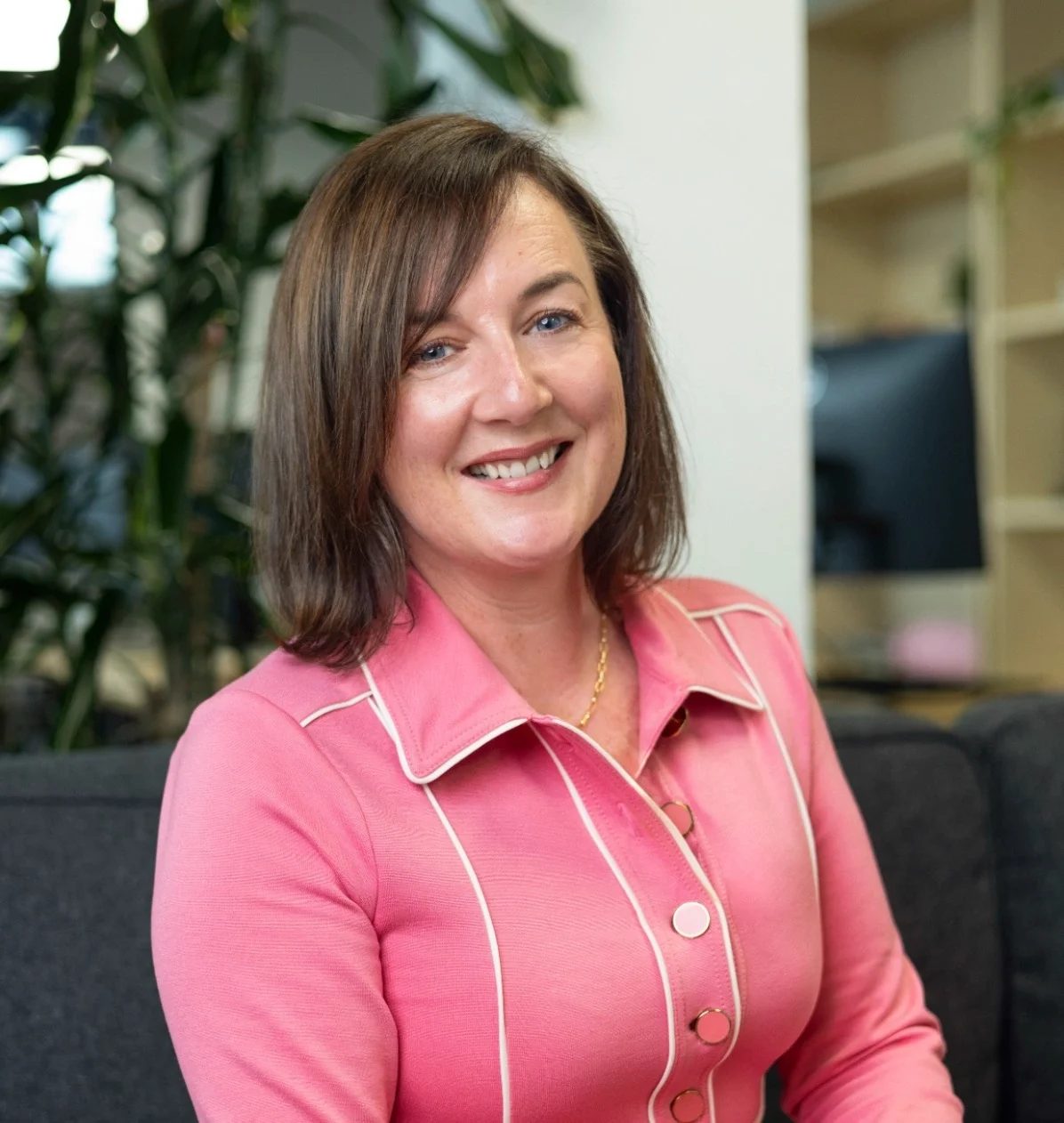

Closing the Gender Ambition Gap With Paula Fitzsimon
For decades, ambition itself has not been evenly distributed. Women were once nine times less likely than men to say they wanted to grow a business beyond themselves, and there was little support built to change that.
This conversation traces how one piece of research turned into a nationwide movement: the peer-to-peer roundtable model behind Going for Growth, its rural counterpart ACORNS, and Back for Business for returning emigrants, along with what today’s data says about ambition, role models and scaling a business.
Joining Larissa is Paula Fitzsimons, founder of Fitzsimons Consulting. Paula was Ireland’s national coordinator for the Global Entrepreneurship Monitor for twenty years and has designed and led some of the country’s best-known peer support initiatives for entrepreneurs, including Going for Growth, ACORNS and Back for Business.
Things we spoke about
- The gender gap in start-up rates and growth ambition
- How one GEM statistic sparked Going for Growth
- Why peer-to-peer roundtables break psychological isolation
- Bringing the model to rural Ireland through ACORNS
- Supporting returning emigrants through Back for Business
Guest Details
Paula Fitzsimons is the founder of Fitzsimons Consulting, specialising in entrepreneurship and growth. She was the national coordinator for the Global Entrepreneurship Monitor (GEM) research project in Ireland for twenty years and served on the global board as President of the national teams for several years.
Paula has designed and implemented tailored peer support programmes for entrepreneurs, including Going for Growth, now in its 18th cycle with more than 1,100 ambitious female entrepreneurs having taken part, supported by Enterprise Ireland and KPMG. She also designed ACORNS, now in its 11th year with over 600 rural women involved, supported by the Department of Agriculture, Food and the Marine, and Back for Business for returning emigrants, supported by the Department of Foreign Affairs and Trade. Paula was appointed to the SME and Entrepreneurship Taskforce by the then Tánaiste and Minister for Enterprise, Trade and Employment in 2020.
Transcription
For your convenience, we include a 95% accurate machine transcription of the conversation. The transcript reflects the video podcast and may differ slightly in the audio version.
Paula Fitzsimons
Just say to yourself now: If I was interviewed by Larissa or by RTE, you know, five years time, what am I going to say? What is my story? What’s your vision for this business? Not just what’s your vision for you, so that it’s bigger than you.
Voiceover
No unicorns, no brands, just hardworking people who built their business from the ground up, sharing their experience so others can learn. Presented by Larissa Feeney from Kinore. This is Real Business Conversations.
Larissa Feeney
Paula, I’d love to take you back to the start of this journey for you in supporting female entrepreneurs in the main, although not all, and you can tell us about that. What sparked that interest initially in entrepreneurship for you?
Paula Fitzsimons
Oh, I’ve no problem telling you about that. It actually was sparked over a cup of coffee. You know the way that I’m a great believer in meeting people for a coffee.
Larissa Feeney
Yes,
Paula Fitzsimons
someone that I had worked with closely was Kieran McGowan, and I was on, let’s call it, a career break while doing multiple things, right? And up to my eyes with small children, right? And Kieran said to me, “Are you busy? Am I busy? I was run off my feet. I was lecturing strategy management to final year accountancy students in the evening, and I was consulting back during the day. Right. Plus, I had, you know, I think I had three, maybe at four at that stage. But the whole, what Kieran said to me was, “Of course you’re busy. You’ll always be busy.
Now, what do you want to do? That’s a very powerful question. What do you want to do? So I didn’t give a knee-jerk reaction to that. I thought about it, and most of my working life, from the time I left college, was actually in the IDA, so that very much had given me a missionary zeal and believed in what we did. But I knew that foreign direct investment was very strong, SME sector at that stage less strong, and there was this new kid on the block. Now this is the late 90s, that was called entrepreneurship, and I felt that if that could be developed.
We’d have the third leg to the stool, right? So you’d have foreign direct, stronger SME because it would be strengthened. The SMEs would have to be strengthened with the sort of challenge from these new kids on the block, right? So that was grand. So after six months, I focused absolutely on entrepreneurship, and I wouldn’t do any consultancy that wasn’t in that way. And I gave up my lecturing at night to focus because, let’s be honest, if you take, you know, a strategic decision to focus in a particular area, you have to focus. You can’t be doing other things and you know bits of everything.
So that was fine, and at the time, I was working with what became Enterprise Ireland, and we were looking at what became HPSUs, and it hadn’t been developed at that stage. And they were saying, “Well, what else is out there, right? And when I looked, I began to think that really we don’t know much about our entrepreneurs as such. Who are they? What’s their background? What do they need? You know, because otherwise you develop a programme or a policy which is driven by your thoughts as opposed to what the market or what your clients actually need.
So I came on a report, an international report called GEM, which is the Global Entrepreneurship Monitor, and I said to let’s call them EI because that’s what they became. You know, Ireland should be in this at that stage. There were 10 countries, didn’t? No, Ireland wasn’t here at that stage. So that was say 99, and there were 10 countries in it, right? So, I thought Ireland should be in it. Made the case because it allowed you to track the entrepreneurial propensity, as it were, of your adult population each year. So you could see was it moving forward or backwards.
It tells you more about the characteristics of your population of entrepreneurs, early stage entrepreneurs, and more established business owners. Also, it gave you an idea of the culture, the supporting culture in the environment. Right, really good. But more than that, it allowed you because it was done in the exact same way in every other country. So, 10 countries in at that stage, and Ireland joined in 2000, and it was very much Paula. Can you get us in, right? So anyway, I got us into Gem, and I saw that they were mostly academics.
So I approached Colm O’Gorman, who is now the professor of entrepreneurship in DCU, and we did Gem. For 20 years, every year. Now going back to what did we learn in those early years? So up to then, there was a general feeling because there was great amount of general feelings around. There was a general feeling that there were more men starting than women, right? But we could pin the numbers down, so we could show there were about two men for every one woman is starting a business, right? And we could show their background, their academic background, their household economy background, their age profile, etc. etc.
Right? Really, really interesting stuff.
So, coming out of that first gem report, we made it clear that there definitely was potential to have more women start businesses. Right now, that was taken up, unbeknownst to us, as it were, by gender equality, which was called NDB gender equality at the time, and they approached the department, let’s call it, of enterprise, who in turn looked to the development agencies and suggested they dis they separate their clients on the basis of gender, right? What gets measured gets done. That was huge, and when the county enterprise boards were set up a little while later, they had a remit particularly about women, right?
So lots of interest in what was happening in women. Nothing that I needed to do because it was happening. Now, interestingly, in that respect, we were ahead of the EU. So the EU in let me see 2003 brought out a white paper which very much identified latent entrepreneurs, and they were females and immigrants. Right now, we’d already highlighted women, so that was fine, and we were doing the report year on year. And when we got to about 2006, coming into 2007, I said to Colm, because Colm ran the figures, I said, Colm, how come?
Didn’t know much social media at the time, but how come I don’t hear about female entrepreneurs much. We know that there’s 800 to 1000 of them. Let’s say it was just 800 every month. Every month, setting up a business. Where are they, right? Because they were not apparent. They weren’t on the radio, TV. There were no podcasts. There wasn’t social media, really. You know, and I just thought about it, and I said, you know, I bet it has something to do with aspiration for growth. So there’s a question. We have this huge database, and within it, there’s a question of early stage entrepreneurs.
How many do you expect to employ? And if they expected to employ 10 or more after five years, we considered them to have growth aspirations. Okay, right. So when we looked in that year, 2006, I think it probably was. I said, “Colm, have a look, and we saw that if we had in the early stage entrepreneurship pool two men for every woman in or about that particular year, there were nine men for every woman who’d an aspiration for growth.
Speaker 1
Wow.
Paula Fitzsimons
Okay. Now Colm would be sitting on my shoulder, and he would say, “Now, Colm, you have to smooth that over three years in case that’s a spike. So if we smooth it over three years, it’s still 5.5 to one, men to women with an aspiration for growth, and that was the finding that I put out. Right, and everyone, oh gosh, oh, we should do something. Oh my goodness, but nothing was done, and that’s the context in which going for growth was set up, and the idea was that it would encourage women in the first instance to be ambitious. We would develop role models.
We’d get them into the newspapers. We didn’t need if nobody mentioned going for growth. Once there were more women featured, and then we would support them to grow their business, so nurture the ambition and then support in a practical way women to grow their business. So that is the background.
Larissa Feeney
So this was 2006, 2007. You you looked at the data, you saw that statistic, you put it out there, and nothing was done unlike what you’d done previously, you had seen a change quite quickly, but for this particular statistic or piece of data, you saw no change. So you decided to make the change yourself.
Paula Fitzsimons
In effect, so what happened in was that gender equality put out a tender Looking for research on women and growth, right? Well, I was researched to death. They could have all the research. They didn’t need to do a tender first, right? And so I wasn’t applying for the tender, right? That was fair enough. And then about 24 hours. Before the tender went in, I knew precisely what they wanted, what they needed, even if they didn’t, and that it wasn’t more research. They wanted action. We had all the research.
We knew that something was needed, so I went in with the proposal that we would develop going for growth. So in effect, they backed that as a feasibility in effect, and I wanted to have national impact from the outset, so designed it as a national initiative. And because I wanted to have national impact, it dictated some of the design characteristics.
Larissa Feeney
Okay, because this this is what I’m interested. I think because I’ve done going for growth. I think it was either 2015 or 2016. So I and I did it at just the right time for me and for this business. So I know the power of the programme. Um, and today in 2026, there’s several. programmes similar to going for growth, but this is 2006, 2007. I mean, there was nothing similar, but so the idea was completely innovative, very very new. What sparked that idea, Paula, of peer to peer roundtables.
Paula Fitzsimons
Okay, very simple. I knew from the research that people, men and women, are both very influenced by their circle, their social circle, their circle generally, and women tended to know more family and friends in their social circle, men knew more business and professional acquaintances, so that was an important thing. So, therefore, we had to get women to know more women in business. Okay, then there was the power of the role model. So, and there’s statistics around this, which I won’t bore you with.
But my feeling was that if you could see a woman who was a successful businesswoman, then you’d believe that you could do it. Particularly if she was giving awards and all, you know. She let’s take a concrete example. So Mary Ann O’Brien, who was one of my original lead Entrepreneurs, she had developed Lily O’Brien’s chocolates, and on the side of the box, she talked about developing the chocolates in the kitchen with Lily. Right? What I wanted to know was, she was at that stage at 20 million turnover. When did she decide to move out of the kitchen? What volume was she at?
How did she finance it? What regulations did she need to meet, and who minded Lily? Because all of that was relevant to people in business. I’ve got to say, when I told Mary Ann what I had in mind, I didn’t know her at all at that stage. She said absolutely, and she was um one of my lead entrepreneurs. Now, the lead entrepreneur name, rather than mentor came because it is what it says. It leads others where the person has gone before, so they are not consultants, academics, or professional trainers. They are entrepreneurs. They don’t know everything, but they have experience of growing a company.
Now, where did the round table come from? The round table actually was one of those necessities which turned out to be a blessing, because I wanted to have national impact, but there weren’t sufficient really high-profile female entrepreneurs to call now. I mean, take Anne Heraty for example. You know, she was busy running CPL at the time, and whatever about getting her once a month, that would only be four persons. Even if she did met twice a month, it’d be two people. No, no. So if she met a group, we leveraged her time with the group.
The magic was what the group learned from each other, and it broke down that psychological isolation and that feeling that you were the only one with imposter syndrome, or the challenges you’re currently going through, or whatever it would be, and that is where the roundtable concept came from. And one would say the magic. Added to that, then because over many years I’d done evaluations and the like, I wanted to measure everything. So I wanted to know if it worked. Because if it didn’t work, I wasn’t going to be wedded to it.
I had plenty to do, so we put in measurement from the very beginning, and we encouraged everyone to have their own goals and milestone, recognising that different people’s goal is different. So each person for themselves with their own goal and milestone. What are my milestones to get to that goal? We’d encourage them to be ambitious and thinking about their goal, but they’d set it down and, in an old-fashioned way, write it down. And then the check-in was on those every month. So not only was the person committed to it. But psychologically, they were reporting on their progress every month.
Now, nobody was going to cut you down at the knees if you didn’t make your progress. So, supposing you didn’t get the website up and running, right? You might say, “Oh, you know, your lead might say, ‘Well, what happened? You know, I say, ‘Well, maybe I couldn’t find someone. Someone on the table say, “I can recommend a really good web designer. Somebody else knows someone who writes content, and another person says, “And I know where you can get support from what would now be your local enterprise office. So that became the magic.
The fact that they were looking constantly at their own goals and milestones to bring them, kept them moving forward. So the achievement in the six months is quite extraordinary.
It’s more than anyone thinks it might be beforehand, and we can measure outcomes across all the initiatives that we do in terms of growth and turnover, employment, a number of new exporters. Besides the qualitative, you know, feeling nearer their goals, feeling more ambitious, more confident, etc. So that is where it came from, and I’ve got to say, in fairness to the EU, they have backed us from the very beginning. So we did the pilot, and at that stage, I’m trying to think. I think we’d Enterprise Ireland behind us. Gender equality had done, we’d say, the feasibility.
Enterprise Ireland did the pilot, a small pilot, and it worked. But towards the end of the pilot, I was invited to Sweden to talk at an SME assembly about going for growth, which I did. And before I went, I was saying to the sponsors, “Well, you know, I hope we’d be saying that it’ll be going forward. And like we were picked out as the, you know, in the top 10 or something of the initiative showcased in Sweden.
They had the presidency that year, and we have gender equality were with us for about seven cycles, and then KPMG came in because of you know a time lag with European money, and KPMG have been with us for about 12 years, and EI have been with us all the way through.
Larissa Feeney
Now I remember specifically the first couple of roundtables that I went to, and back in those days, and probably still the case, a lot of the going for growth roundtables took place in Dublin. I’m obviously in Donegal, so it was it was a big commitment for me to do it. There was no question in my mind once I got on the table that I was going to do it, but I specifically remember the mindset shift that happened for me, and that was, for the first time, I became aware that I wasn’t the only one going through whatever the issue of the day was.
Right, that everybody around the table had either been through it, or was going through it, or would go through it. That was a huge shift for me. Is that normal, Paula?
Paula Fitzsimons
Absolutely, absolutely, 100% 100% That’s when I’m talking about the break in psychological isolation, right? So that you no longer feel alone. You no longer feel that you’re the only idiot, right? And you could see then on the other side, you could see people be ambitious. Now the interesting thing is that if I was to have thought about it at the beginning in terms of the communication flow, I would have thought it would have been from the lead who has all the experience going out, but actually it’s circular, right? It’s circular.
So the lead facilitates, lends her experience in, but encourages the others to share with each other. And we’re very careful that there are no competitors on a round table, and the culture that has been developed over time. Well, I think always was confidential. Everything that’s discussed in the room stays in the room absolutely, and has always been collaboration. So I’ve been asked at times, you know, would you have an award for best going for growth through the year? Absolutely not. You’re a winner if you’ve got around that table, right? So all are equal in the care that we give them and in themselves, right?
In their business. And the next thing is respect, and the respect is for the lead entrepreneur, all of whom are volunteers, right? All of whom are given their time for nothing. So I expect that the participants will be fully present when they’re there, not with the phone up and checking it with emails. No, fully present, and that they will respect the time of the lead entrepreneur. But more than that, they will respect those who are round the table, because you have those who are talking and articulate, and you’ve quieter people.
That doesn’t mean the quieter person hasn’t an equal share at the table, and they should be encouraged to talk and given space to talk, right? And it’s quite interesting because one of the guys who was down doing a bit of filming for us at one stage said to me, “Who would you like me to interview, Paula? And I said, “Talk to anyone. And he said, “How can I? How can you be sure? I said, “Talk to anyone. And no matter who he put a mic under, they were able to talk, and that’s the way it should be. There’s no favourites. These are top five.
Always interview. No, no, no. Talk to anyone, right? And so the feedback year on year on year is tremendous, tremendous in terms of growth in sales, employment, exports, but also in those soft things, and in the friendships made, right? In the friendships made, there’s no doubt which have last lasted for years and years, and I still am interested. And you know, they laugh at me. I’d sit up in bed and I read the feedback, right? Because I’m looking all the time: how can we improve? What do people need? Are there changes that we can help them with?
Larissa Feeney
Yes, to all of that. And to add to that, I would say there’s huge value in the networking opportunity. So yes, to friendships, but the networking opportunity and the cumulative effect of many different tables over many years, many ambitious female business owners supporting each other over many years is huge. I mean that network delivers continually if you invest in it, it is absolutely, absolutely valuable.
Paula, I suspect you’re going to tell me that more research led you to ACORNS, and I know that the ACORNS 12 call has just opened, and we’ll put the the the link to that in the show notes, but I’m guessing that there was some research because going for growth, well, certainly whenever I did it, as I said already, I travelled to Dublin. There was nothing at that time in rural Ireland. Nothing. There was very little even in Dublin apart from going for growth. Did something point you in the direction of rural female entrepreneurs.
Paula Fitzsimons
A question from the Department of Agriculture.
Larissa Feeney
Okay,
Paula Fitzsimons
yeah, they were very interested in encouraging enterprise in rural Ireland, and I was saying to them, “Are you sure that it’s gender? You know, we it’s a female one because you know I’m not just about women. Like I’m happy to help entrepreneurs, men and women, right? And they said, no, no, definitely, they felt that women in rural Ireland needed strengthening. They needed there needed to be more enterprise at local level to encourage people to stay in rural Ireland, men and women, right?
So they put out a tender, and I responded to it with ACORNS, acceleration the creation of rural nascent startups, and that’s 12 years ago at this stage. They have they backed it then, and they’ve backed it every year since. I mean, I’ve done loads of tenders for it, but it’s it’s very special is ACORNS. It’s very special, and partly because it delivers at local level, so everyone doesn’t have to get their way to Dublin. But also, rural Ireland is quite different to Dublin, right?
So if you’re doing business in rural Ireland, it’s not the same, and you don’t have the same networking opportunities and all the other things. This was before digital really became into its own, but you don’t have the same opportunities. And two differences we brought in there: one was that we use the same model, by and large, but that the lead entrepreneurs would all come from going for growth community, so that they would have understood how a roundtable should work, and secondly, that they would all have started and grown business in rural Ireland, right?
Because they understood the challenge not just of being a woman in business, but being a woman in business in rural Ireland, so that you had that connectedness, and I tap people on the shoulder about them coffees or whatever. I’m sure you never got a coffee, Larissa, but it was a case really of saying, okay, if I look at the country, I want a lead entrepreneur in the various regions, but they have to be a successful businesswoman who is a role model within her community, and that’s where ACORNS came from.
Also, from the design from the very beginning, because I felt people were more physically isolated in rural. That they might be, you know, more Dublin centric. I wanted to build in a residential, so there’s a residential built in, in Mullingar. Everything is outside Dublin, and that’s at the beginning, at the launch, and also at the end of the cycle. There’s a residential, and that works. That’s when the, you know, the real connections are made. There’s no doubt about it, and people meet more than just their immediate roundtable. They’re meeting other people from different parts of the country with similar issues.
Larissa Feeney
Do you think that’s what makes it so special? Then is the the residentials on either side of the six months? The
Paula Fitzsimons
residential absolutely works. There’s no doubt about it. But to me, look, I was born in the county Dublin, right? So it’s not that I’m I’m saying this without prejudice. I think there’s something special about people in rural Ireland. There is no doubt about that. Their enthusiasm, their commitment. I mean, we’re looking at 94% attendance at all the roundtables. For example, one woman in Kerry was on a round table last year, but it was very difficult for her to get by public transport, even to where she was going, Limburg or somewhere. And what did the other girls used to put her up overnight?
Do you know what I mean? Like they really believe in helping each other in whatever way they can, and we also have sort of like a showcase to help people know what the products are, so they can buy from each other and all the rest. And they absolutely do, and they champion each other. And every time they stand up in any occasion. They’re talking about ACORNS and the opportunity afforded by the Department of Agriculture, Food, and the Marine. And in fact, this year’s Ireland ambassador for UN Year Doorman Farmer is ACORNS. Is an ACORNS lady, Karina Rosen Rosengrave, right of Bureview Farm.
Now we don’t take farmers per se; we take enterprise. So she was actually developing eggs, right, as an enterprise and something that was sowed off the farm. Um, and I’m blown away constantly. That’s great to get away from the office because on Friday I met various of the ladies from different parts of the country to do the new launch of ACORNS 12, and the enthusiasm-they didn’t know each other, right? But it’s like a secret handshake. The enthusiasm, the feeling of solidarity, and all moving forward together with a range of innovation, different types of businesses. You know, rural Ireland’s alive and well thanks to women.
Larissa Feeney
Yeah, no, absolutely. If if you were to talk directly to a female entrepreneur, either in rural Ireland or not, who’s thinking of applying either to ACORNS or to a future going for growth cycle, which will probably be open later in the year. What should what are the lead entrepreneurs looking for? What are you looking for? Because the competition is fierce, Paula, isn’t it? To get on these programmes, yes,
Paula Fitzsimons
yeah, yeah. I mean, the competition is four to five applications for every place, and we don’t interview, and we don’t ask you to do a pitch. It’s just an online application, and the online application is very straightforward. I would say the first thing the person should do is really think about it, because entrepreneurship is not easy. So it’s not. It shouldn’t be just a knee jerk reaction. Oh, yeah, Grand, I’ll set up a business, right? Because it’s hard, and the terms and conditions can be stressful, so it may mean that you can’t, you know, maternity leave.
You don’t sort of can take the same amount of time off, or holidays become more problematical when you’re very small. So I would say, wherever you are, whatever you’re starting, don’t just create a job for yourself, right? Be looking to employ others. So we tend to make that as a criteria in ACORNS, which you know by larger micro businesses, right? Some of them grow and come out of the sort of that rural Ireland micro business cohort. Growing your mullet in the scrot chocolates. You have all chocolatiers, the supreme champion last year, Blossingher.
You have Geraldine Jones, Skin Formulas, and Geraldine is now back, having gone through going for growth as well. She’s now back as an ACORNS lead entrepreneur. So it doesn’t matter where you start. Don’t be the limit of where you achieve, of where you can get to, right? And I would always say, if anyone came on the phone to me and asked me that question, I would say, go for a walk, and drink. You could be walking the dog, walking the kids. Doesn’t matter, and just say.
To yourself now, if I was interviewed by Larissa or by RTE, you know, five years time, what am I going to say? What is my story? What have I achieved? And then you work towards that, and in a way, that’s what you put down in your application form. What’s your vision for this business? Not just what your vision for you, so that it’s bigger than you.
Larissa Feeney
That’s great advice because it is it is one application form. It is very straightforward, but by being one application form and by being very straightforward, it does mean that you do have to put a lot of thought into it in order to stand out. You know, having reviewed them myself over many years, it is really difficult. So the more work that the that goes into the application in terms of demonstrating ambition, growth plans, and as well as describing what has been done so far is is is vital.
Paula, moving on a little bit now because there has been a couple of other programmes, the Back for Business programme, for example. If if if you could talk to us a little bit about that, because that’s not just for females.
Paula Fitzsimons
No, it’s not. It’s quite interesting. You know, could we? Would the model which was designed for by a woman for women could that model work in a mixed gender situation? And the answer is absolutely yes, which is wonderful. That was a situation where the Department of Foreign Affairs and Trade were thinking, what could they do for the diaspora? And of course, at the time that they were looking, I could get three of my four children away, and I was thinking, what do they need?
But much more, I’m only focused on entrepreneurship because I would say, in terms of the strategy, people have to be very focused on what it is that they’re about. So, what we wanted to put in place was a support for those who are returning from overseas and wanted to set up a business? Now there is research from that coming from Jem, and the research would say that Irish people who have travelled abroad and lived abroad for at least a year are more entrepreneurial than those who have never travelled,
Voiceover
which are Irish
Paula Fitzsimons
to Irish here. So it was very interesting to tap into that, and it was for men and women, and I would say that we’ve about 60% men and 40% women. So it isn’t a case of just being known for the support working for women, and it’s using the roundtables facilitated by successful men or women, and counting and measuring the progress over time, and it’s working very well. Now, it’s for even earlier stage because they’re coming. You know, they’ve only arrived back in the last year or two, and just setting up many of them. The business isn’t actually up and running at that stage, right? So, so idea stage maybe,
Larissa Feeney
yeah,
Paula Fitzsimons
yeah, and just a bit beyond. So they’re even earlier than ACORNS. So I would say about 85% of ACORNS of those selected there thereabouts are already trading, even in a very small way. Bank for business, they’re not right. There, it’s the other way round. You know, about 30% of them would be already trading more at the end of the cycle, and we look for them that they’re ready to go. But it has absolutely worked. Now there is a difference. So the difference that’s distinct in back for business again measuring, measuring, asking, asking, is the lack of network. So there, at least 10 years.
Well, on average, 10 years out of the country, they come back. They think they’re coming home, but everything has changed, and they’re thinking you set up a business like doubly hard. Where do you go? What do you do? And part of that, we introduced a support day where the development agencies, microfinance, credit review office come together personally and are available to them to discuss what they have and how they might support them. The other interesting thing is that 80% or thereabouts of the back for business people are actually locating outside the Dublin area.
Larissa Feeney
Oh, that’s fascinating. They’re not unlike ACORNS in that there is a lack of network, a lack of network, um, similar to what you raised about the ACORNS, and as you say, more rural than not.
Paula Fitzsimons
Yeah, yeah, yeah. Certainly, they’re outside Dublin. I mean, some of them might be in Cork, some of them might be in Galway, so in ACORNS you have to be outside the city boundaries. Okay, living outside the city boundaries, not necessarily for back for business, but it’s an observation as opposed to a criteria we put in. So the observation is that 75, 80% are outside Dublin, but by far, by far, by far. The highest, what is your challenge in setting up your business, is lack of professional network. They know nobody.
Larissa Feeney
Yes, and they don’t even know, or they probably find it very difficult to be, you know, to know where to go because of that lack of network. Okay, really, really interesting.
Paula Fitzsimons
Yeah. Whereas in ACORNS, you know, they’re based in different counties, there’s the local enterprise office in the county, and they’re active and all the rest of it. These guys and girls don’t even know that there’s Leos.
Larissa Feeney
Yeah, yeah, yeah, yeah. And what the Leo does, yeah, it
Paula Fitzsimons
it is slightly different, but that confidentiality, collegiality, and respect runs across all the networks,
Larissa Feeney
fascinating. And how many years has Back for Business been running then at this stage?
Paula Fitzsimons
So we’re going into the 10th year, hopefully.
Larissa Feeney
Oh, very good. Okay, okay. And see, Paula, whenever you look at the research today and what you see today, the the support that female entrepreneurs and indeed male entrepreneurs need. Are there needs been met by the current supports that are available, or is there something that you’ve seen that is developing that we need to work harder in some area to help support those that are starting businesses or indeed trying to scale businesses?
Paula Fitzsimons
Okay, well, I think in many respects, one of the things that one has to look at is the type of business that women start. Now we know from Jem that women tend to about 60% or thereabouts of women are in consumer-facing businesses. Fewer are in business-to-business type businesses. More men are, and if you look at business angels or those who need financing to scale, the VCs and the business angels are much more comfortable with a technology play, right? And many women aren’t in that space, right? So I mean, now everyone will say, “Oh, Amy Connolly, if you as one of our super entrepreneurs, right?
But if you had said female in the beauty business 10 or 15 years ago, people would have laughed at you, and they’d say, “How could they compete against L’Oreal or all these big names? Right? But they have demonstrated that they are able to do so, and I think in many respects there has been a change in consumer behaviour, so that you find that consumers, instead of following crowd, want to stand out as different. I remember Guinness had an ad many years ago, and it was every drop different. And I thought, you know, they’re trying to mirror that, but that’s why you got the microbreweries.
That’s why you have many of the offerings that ran skincare and the like. People are prepared to try something different, and so I think that’s important. Now going back then to your original question, I think there is still a need to encourage women to be ambitious. There are much more role models, and you know many of them have come through Going for Growth. And there are many awards and women getting a high profile, and they’re very good on social media. I’m delighted about that.
And interestingly, if I was to look at going for growth, say we have 11 lead entrepreneurs, you know, who are leading a cycle. Nine of those are previous participants. That would that would not have been heard of. All our ACORNS, our past participants, right? They’re all going for growth members, and in bat for business, we have three females and three males. The three females are all from the going for growth community, right? Now, that’s not to say we just blinkers and we won’t look at anybody else, that isn’t true, but the talent that has grown up, we now have the role models.
We need to allow them to scale, and we need to support them to move forward. I would say, in many respects, there’s probably not just the gender lens, but other lenses that could be put on the population to say, where do you need support?
Larissa Feeney
Yeah, definitely, I would agree because if you look today at the support that’s available for female-led startups, and there’s loads, and that’s right, and that should continue. But I wonder, is there an opportunity to support females and males at a different level, you know, perhaps to to scale, there’s just not that many. I mean, you could pick a number, you know, 10 million, 50 million, 20 million. You know, that at that level, which is a very different beast. And I wonder, is there an opportunity to support there? Because there’s a lot of support at startup stage.
Paula Fitzsimons
Yeah, yeah, yeah. I would agree with you, and we like to think that we’d be there for people’s entrepreneurial journey. And what my next thoughts would be is how to further develop those in the Going for Growth community, so that they can actually continue, and we continue to support them along that entrepreneurial journey, because I think there is a challenge, and the challenge is something that confronts everyone, which is that when you start off and you get almost like a badge, I’m an entrepreneur because you’ve seen an opportunity, gather resources, and you implement right.
But what often happens over time is that that same person becomes a manager of a business they happen to own. So you go into steady state, right? And what we try to do is to break people out of that steady state to find their entrepreneurial spirit they started with, right? And tap into that, and to move them up,
Larissa Feeney
right? Because that’s exactly the the that’s the a tipping point almost where the business might be doing really well, and the founder might be taking a decent salary, and the the thought of having to risk all of that to go again, even if you are an entrepreneur at heart. That can be a very difficult decision because it’s a different beast if you’re employing 2040, 60, 100 people. It’s not just your mortgage that won’t be paid if it doesn’t work out. So that’s difficult, I think, at an individual level to make a decision to go and risk you.
Like for example, Paula, you often see entrepreneurs who start a business and exit and then start again. You, if you viewed one business as continually starting again, can you imagine where you could possibly bring it to with with those skills?
Paula Fitzsimons
Absolutely, and I think you know there has to be ways for entrepreneurs to take some money off the table to actually give them a sense of security. So it’s not just everybody else who works with them have the sense of security. Yeah, I mean, I see it close up because I’ve family who are entrepreneurs and all the rest of it, you know. And I sort of think at times, what have I done? What have I done? You’re the same way. You would be role modelling within your family, right? So people would say, “Oh gosh, look what mom does.
You know, there’s no reason that we can’t do it, right? Yeah. But go back to the point: it’s not easy. Sometimes I wonder if the word entrepreneur, well, I feel it should be an adverb or an adjective, so that it’s a continuous process. But I wonder, does it get us too much in people’s understanding that it’s just founders, that it’s just people who start? Maybe we need to call it businesswomen, or I don’t know, but certainly growers, if you know what I mean, people on that growth journey who want to continue on that growth journey. That’s my next challenge.
Larissa Feeney
Yeah, that I see that, and I agree. I agree with you on that, Paula. What has changed? See, whenever you looked at those at those gem figures way back in the early and mid 2000s, 20 plus years on. So in those days, the figures you quoted earlier on, two to one, female versus male that were, or male versus female that was starting businesses, and 5.5 to one that had growth aspirations. Have those numbers changed in the last 25 years?
Paula Fitzsimons
So we haven’t done Gem since 2021. But if I reflect, okay, if I reflect on the last Gem figures we did, I have good news. There’s about 1300 women every month setting up a business, so more women are starting, but very interesting. More women are growing. They have an aspiration for growth. So we were looking at 5.5, smoothing it over three years for Colm, to one, smoothing it over three years, 2.5 to one. So the aspiration for growth is growing among women, and the role models are there, right? The role models are there. Look at yourself, Larissa. You know, women in Donegal.
See how successful that you are, and then know you from walking the coast or up a mountain or wherever with your family, and say, “Well, sure, I know, Larissa, you know. And don’t take me wrong in this, but she’s an ordinary person, and that is the point. You two can do it, right? They have to have the aspiration, the belief, the dedication, and then the support, as well as natural talent and hard work,
Larissa Feeney
and that’s down to. I mean, that drop is is massive. I know it’s taken 20 years, but I mean, it’s a massive drop. But it’s down to what you said at the beginning. You know, your aspiration to get these female business owners in the newspapers today. We would say, of course, in social media. Back then, you probably didn’t say that, but. That’s what you meant, right? Make them more visible, and you know, make them accessible for for ordinary people. So that has worked, Paula. What’s the number one piece of advice you would give to an ambitious business owner now who’s trying to scale their business?
Paula Fitzsimons
I think if you want to scale the business, the business must itself have something fundamentally unique or different about it. So I think you know you need to be focusing on your customer, understanding who your customer is and what their particular needs are, and then your execution has to be flawless, right?
And your developing process over time so you can deliver at scale, never taking your eye off the customer, and then I think it’s probably-I mean-it’s something close to your heart-is understanding the numbers, because if you don’t understand your numbers well, you won’t know where you’re making money and where you’re not making money, and be able to make the right decisions with regard to moving your business forward. I think that is a, you know, it it sounds so fundamental, but it’s like taking the pulse of the health of the business.
Larissa Feeney
Yeah, it’s how we keep score, understanding the numbers, understanding your customer, and where going for growth and ACORNS and back for business come in is also understanding yourself because you can see through the peer-to-peer learning around those tables where perhaps you have gaps, and in order to grow the business, you have to grow yourself. And taking part in these programmes is part of growing yourself. I would say,
Paula Fitzsimons
yeah, I would agree. I would agree. And actually, the interesting thing is that those who become lead entrepreneurs say, even though they’re volunteers, that that is part of helping them grow, because all the time you want to challenge yourself to keep yourself open in terms of learning, but also to surround yourself by others in the same boat. So, all of the Acorn lead leads, you know, by and large, are trying to move forward their businesses themselves at that different level. The same, the going for growth leads, and I would think that there may be many initiatives out there, and I’d say good luck to them.
But we have something unique, and we will continue to build and look after the community and develop opportunities for them to grow and scale.
Larissa Feeney
And you really do that very well. My final question, Paula, is looking across all of the 1000s of founders that you’ve supported. What has been your proudest moment?
Paula Fitzsimons
I don’t know. It’s very hard to say because I never pull out a single person. Every time I’m at a celebration, every time there’s a group together, when I see, you know, let’s take a particular acorn who started and came in hardly with the courage to say her name, and I see her six months later standing strong, saying that she’s a businesswoman. That is success to me. Seeing someone whose scaling we talked about Amy Connolly early. Earlier, I mean, she went starting strong, going for growth, continuing the momentum. You know, I’m proud of her. I’m proud of you. I’m proud of you all.
And I deal in such positive news, I believe, and I intend to keep going because I absolutely love it. It’s part of my. You like all my extended family. So I, how can I choose between my children? You know,
Larissa Feeney
what I find amazing every year, without fail, whenever I see the ACORNS Group and Day One, and the ACORNS Group six months later, it’s they’re like different. It’s they’re like different people because, and I mean, for anybody listening who’s who’s considering applying, you know, you you come in and you meet a group of business owners who almost feel like they don’t deserve to be there, and they can’t believe that they’ve been selected, and they can’t believe that they’re among this group, and this is just overwhelming to them. And then six months later, they’re standing strong. Their shoulders are back, and they’re very confidently telling their story about their business growth. I mean, that journey is-it’s fascinating to see, isn’t
Paula Fitzsimons
it? Absolutely, absolutely. And in fact, we have the launch of ACORNS is always in a large hotel in Mullingar with a large, with a very long hallway, and you look at the people having to walk down that hallway, and they’re nervous. We have brought the the registration desk up further, so people aren’t. Feeling as intimidated, but you’re absolutely right to see the growth in six months, and then when you look at the growth, you know we’ve had nearly 600 people through ACORNS.
I would say 400 are still involved in the community, and to watch their growth-not only their growth and development, not only in that six months, but going forward, they can do ACORNS Plus. They can come to community forums, they can continue to support each other, and I have to tell you, and you may know, but you have organic chapters now being formed. Yes. So there’s one in Sligo. They met with yourself in Donegal celebrating 10 years, and then they thought, “Oh, there’s quite a few of us from Sligo. Why don’t we do our own? And they’re using the same template.
We’ve a recent one started in Louth. Wow, that’s organic growth in that true sense.
Larissa Feeney
Yes.
Paula Fitzsimons
So all of those things give me pride, and you know I get great satisfaction from them.
Larissa Feeney
Paula, thank you very much. Paula Fitzsimons, founder and principal of Fitzsimons Consulting. Thank you so much for sharing your incredible insights with us today.
Paula Fitzsimons
My pleasure.
Voiceover
Thank you for listening to Real Business Conversations with Kinore. For more information on this episode, see the description area of this podcast, or visit our website Kinore.com. Remember to press follow on your podcast player now, so you’ll get a brand new episode every single month. This podcast is produced by Dustpod.io for Kinore Finance and Business Services.